The Modern MSSP Playbook for Expanding Attack Surfaces and Rising Customer Expectations
The Modern MSSP Playbook for Expanding Attack Surfaces and Rising Customer Expectations Every MSSP...


“We are not short of cybersecurity capability. We are short of connected cybersecurity.”
Every discussion, whether on AI agents, identity, exposure management, or vendor consolidation, eventually pointed to the same friction. The systems are advancing, but they are not aligning.
Cybersecurity is struggling not just with threats, but with scale, fragmentation, and the speed of change.
The real issue is not absence of capability. It is the inability to connect it into a coherent view of risk.
That is the shift now defining the industry.
Gartner highlighted that by 2029, a significant portion of midsize organizations will move toward consolidating these domains into workspace security platforms that enable centralized policy enforcement and more coherent control.
Security teams are operating across fragmented systems where identity decisions, endpoint activity, and data movement are still managed in separate silos. At scale, this separation creates gaps in visibility and enforcement. It also increases the time required to correlate risk across domains.
As a result, organizations are beginning to move away from treating identity, endpoint, and data security as independent functions. Instead, they are being evaluated as part of a single operational layer that governs access, behavior, and protection within the digital workplace.
Priority Intelligence Requirements are beginning to replace broad threat intelligence streams as the primary way organizations prioritize risk. The shift is being driven by a simple problem: continuous flows of raw intelligence are no longer helping security teams make clearer decisions, they are overwhelming them.
In response, Continuous Threat Exposure Management is emerging as a more structured approach to understanding where exposure actually exists at any point in time, instead of reacting to disconnected or isolated signals.
This is also starting to influence how exposure management and threat detection and response are working together. The direction is not toward combining tools or aggregating more data. It is about improving how decisions are made using shared context.
More data, without that shared context, does not improve outcomes. It increases operational noise and makes prioritization harder, not easier.
Gartner notes that 20 or more cybersecurity vendors exist in 37% of enterprises. In addition, 62% of companies are pursuing vendor consolidation and 36% plan to do so in 0–3 years.
This reflects a broader structural challenge in enterprise security environments, where fragmented tooling has led to overlapping controls, duplicated capabilities, and reduced visibility across domains.
As a result, vendor evaluation is shifting beyond feature comparison toward more outcome-driven considerations. Organizations are increasingly focusing on whether vendors can consistently deliver security outcomes, how much of the security landscape they meaningfully cover, where capability overlaps or gaps introduce risk, and whether value can be assessed continuously rather than only at the point of procurement.
This is also contributing to the rise of strategic cybersecurity vendors that operate across multiple domains rather than addressing isolated problem areas.
The overall direction is toward reducing fragmentation and improving coherence across the security ecosystem.
AI is now simultaneously a force multiplier and a new attack surface.
Security leaders are already dealing with AI application compromise, prompt injection attacks, and deepfake-based identity impersonation. These are not future risks. They are already shaping how systems are being targeted and manipulated.
AI agents introduce a deeper layer of complexity. These systems can operate autonomously, update behavior at runtime, and interact with enterprise systems in ways that are not fully deterministic.
This creates new categories of risk, including:
A key insight from the sessions was that many successful attacks against AI agents are expected to exploit access control weaknesses rather than model-level weaknesses.
In response, guardian agents are emerging as a supervisory control layer. These systems are designed to monitor and enforce boundaries for AI agents.
The approach is deliberately phased:
The goal is not full automation of control, but controlled autonomy with governance layers.
Across sessions, there was a clear acceptance that prevention is no longer the dominant measure of security success. Organizations are moving toward a resilience-first model where the focus is on:
This shift is being driven by a combination of AI-enabled attacks, geopolitical instability, and increasing system complexity.
Rather than assuming that all threats can be prevented, security programs are now being designed around the assumption that disruption is inevitable.
Resilience is becoming a core design requirement, not a secondary outcome.
One of the more thought-provoking discussions was not about technology, but about leadership.
For years, the CISO’s success has largely been measured by operational outcomes. Prevent incidents, manage risk, maintain compliance, and keep the organization secure. While those responsibilities remain essential, the expectations of security leadership are changing as organizations become more digital, more interconnected, and increasingly dependent on AI-driven systems.
The role is evolving in several important ways:
This represents a significant shift in mindset. The CISO is no longer expected to simply protect the organization from risk. Increasingly, they are expected to help the organization operate, innovate, and grow in an environment where risk is a constant reality.
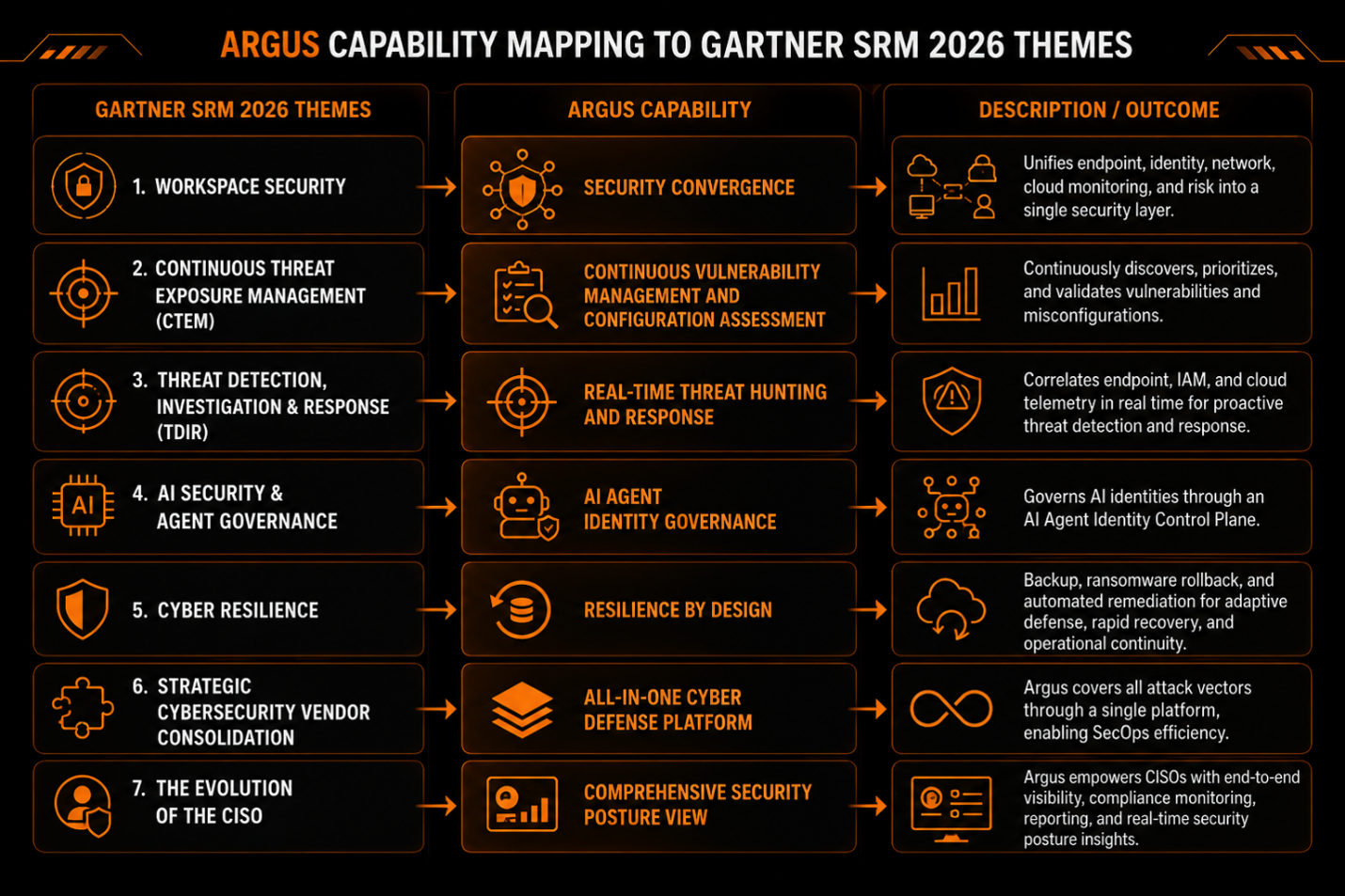
When you step back from the themes discussed at the Gartner SRM Summit 2026, a clear direction emerges. Cybersecurity is no longer constrained by a lack of capability, but by a lack of connection between those capabilities. Identity, endpoint, cloud, data, exposure, and now AI-driven systems are all evolving rapidly, but they continue to operate in silos that slow down decision-making and fragment risk visibility. The industry challenge is shifting from building more controls to making existing controls work together in a meaningful way.
Across CTEM, AI agent governance, vendor consolidation, resilience, and the evolving role of the CISO, the common thread is convergence through context. Security effectiveness is increasingly defined by how well organizations can correlate signals across domains and translate them into coherent, business-relevant risk decisions. Without that shared context, even the most advanced tools create noise rather than clarity. This is why resilience and exposure-led thinking are becoming central pillars of modern security strategy.
This is also where the direction of Argus naturally aligns with the industry’s trajectory. Security Convergence, as a foundational principle, reflects the need to unify identity, endpoint, cloud, network, and AI agent ecosystems into a single intelligence fabric. The focus is not on adding more layers, but on reducing fragmentation so that risk can be understood and acted upon consistently. In that sense, Argus is aligned with where cybersecurity is heading – a connected, context-driven security operations rather than isolated domains of control.
The Modern MSSP Playbook for Expanding Attack Surfaces and Rising Customer Expectations Every MSSP...
Argus v2026.01 : Now with extended IoT security, Vulnerability detection, and Android security. Argus...
The Hidden RAT: Detecting PureHVNC with Argus by Genix Cyber What is PureHVNC The...