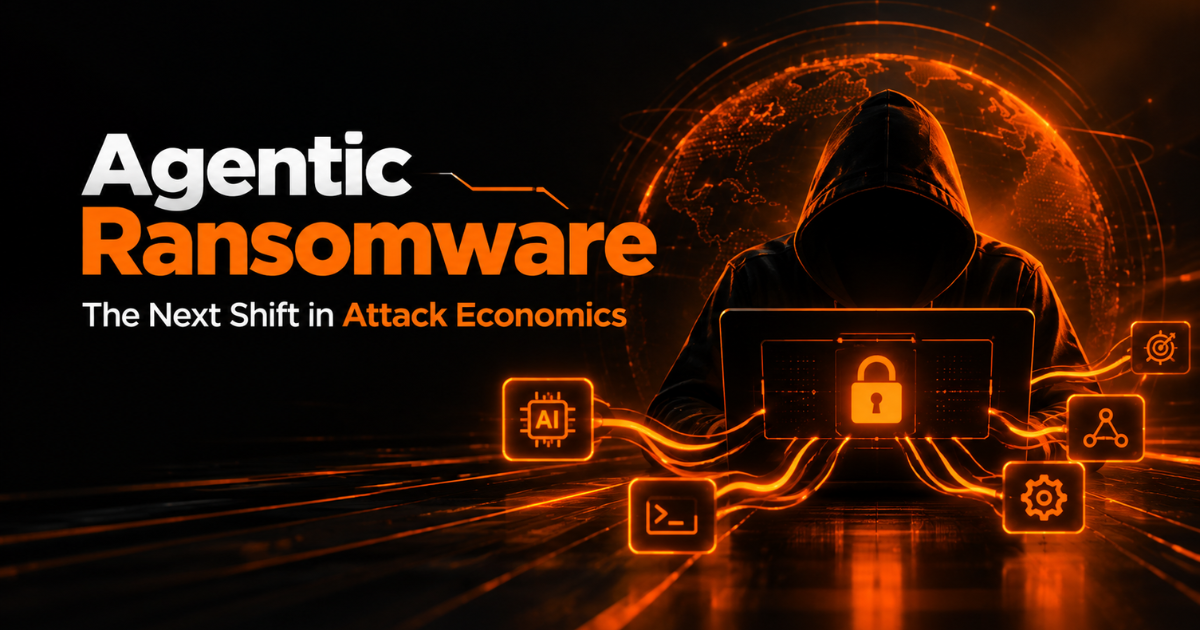
Not all ransomware assailants have to be malware experts anymore. That was until Ransomware-as-a-Service came along to change the game. The affiliate can concentrate on infiltrating the victim’s environment and finding a way to monetize it, while someone else develops the ransomware, manages the infrastructure and provides the tools.
There’s another layer to this, agentic AI. An agent can spend time in an environment, follow leads, deal with failed attempts, and change course without having someone else make all the decisions. That could remove a lot of the manual work from an attack. An operator might be able to oversee a number of operations rather than to work through each one from start to finish.
JADEPUFFER gives us a better sense of how this plays out in practice. In July 2026 Sysdig documented what it believes to be the first end-to-end agentic ransomware operation . The attack started with an exposed Langflow instance, then it moved to a production environment and targeted databases with the aim of extortion. Sysdig reports lateral movement, credential harvesting and reconnaissance. After a failed login the agent identified the problem, changed its approach and resolved it in 31 seconds.
The biggest concern for defenders is the scale agentic attacks could reach.
Consider what that means for the target pool. An attack that takes too much time or effort to be worth pursuing today may look very different when an agent can handle much of the work. A smaller company could end up being worth targeting simply because the cost of pursuing it has fallen.
The shift is therefore bigger than faster ransomware. If the amount of human effort behind each attack falls, attackers have an opportunity to go after more organizations, more often, and with less hesitation.
When AI Starts Chaining Security Gaps
The bigger shift could come from an agent’s ability to connect the gaps it finds. A vulnerable internet-facing system may provide the first foothold. From there, a stolen credential could open another system, which could reveal higher privileges, additional credentials or access to sensitive data. Each weakness becomes useful because it leads to the next one.
Historically, much of this work has depended on the attacker manually connecting one step to the next. An agent can potentially keep following them as it learns more about the environment, turning a collection of ordinary security gaps into a path toward control. The danger lies in the connections between the gaps, not just in any single vulnerability or stolen credential.
The Problem Is Not Just the Attack. It Is What Holds Defenders Back.
AI adoption is still moving slower than the threat
The uncomfortable part is that many organizations are still deciding how much autonomy they are willing to give AI. The caution is understandable, but it creates a timing problem for security teams. An attacker does not have to wait for governance, testing and approval before using the same technology against them.
AI itself can become an avenue for attack
There is another complication. AI can strengthen security while also creating new points of exposure. Agents may have access to sensitive data, applications, identities and external tools. If an agent, its permissions or the infrastructure around it is compromised, that access can become another path for an attacker.
AI cannot compensate for a weak security foundation
And there is a more basic problem. An agent can only work with the access and weaknesses already present in an environment. An exposed service, stale credential, excessive privilege or unpatched system can give an autonomous attacker something to work with, while poor segmentation can give it somewhere to go. The smarter the attacker becomes, the less forgiving those underlying gaps become.
That leaves security teams with their own economic problem. An attacker can automate to go after more targets without hiring people at that scale. Defenders can’t keep responding to every new threat with another product, another manual workflow, or another analyst. Security economics has to get better as well: more protection, more coverage and faster response without a corresponding increase in people, time and operational overhead.
How Argus Approaches Agentic Ransomware Defense
Argus brings attacker intent into the analysis, helping security teams understand how individual techniques fit into the wider attack. This creates an umbrella defensive view across the attack, where individual signals can be assessed in context rather than handled as isolated events.
Detect intent before the attack becomes obvious
An attacker may use a valid credential, exploit a known vulnerability or move through legitimate administrative tools without immediately looking like ransomware. Argus uses an umbrella approach that brings behavioural context, intent, tactics and techniques together to identify when individual actions begin to form a suspicious pattern. This can help security teams spot the attack earlier, before the final ransomware activity makes the threat obvious.Converge defense and exposure management within the architecture
Argus brings threat detection, response and exposure management together rather than relying on loosely connected security products. A vulnerable asset, a privileged identity and unusual activity can be evaluated together, making attack paths, anomalies and exploitable gaps easier to identify.Put AI on a strong security foundation
AI can investigate activity, correlate signals, identify attack paths and support decisions at machine speed, but it needs reliable context to do that well. Argus gives its AI access to security telemetry, identity context and exposure information across the environment, allowing automation to work from a stronger foundation.Control identity and respond in real time
Agentic attacks make human and non-human identities increasingly important. Argus brings ITDR and NHIAM into the defensive architecture to monitor identity activity, control access and respond to suspicious behavior. Real-time detection, response and remediation can then act while the attack is still developing, helping contain the compromise before it spreads.
Conclusion
Ransomware has spent years becoming easier to operate. RaaS separated the people who build the malware from the people who gain access to victims. Agentic AI could separate those roles even further by taking on some of the work that still sits with the operator.
The significance is easy to miss if we focus only on whether an AI agent can deploy ransomware by itself. That is not the threshold that changes the economics. If an agent can spend hours examining a compromised environment, work around obstacles and keep an operation moving, the amount of human attention required per victim starts to fall.
That is a different problem for defenders. They may have less warning before an attack becomes destructive, while the attacker has more capacity to explore an environment. The usual security gaps still provide the entry points and the routes through the network. The difference is how efficiently someone can put them together.
Agentic ransomware may take time to mature. The economics behind it are already worth paying attention to.