AI has moved remarkably quickly from something organizations experimented with to something they are actively building into products, workflows and everyday operations. AI agents are beginning to interact with enterprise applications, models are gaining access to business data, and automation is taking on tasks that previously required people to make every decision along the way.
There is good reason for the enthusiasm. AI can remove friction from processes that have remained manual for years, help teams analyze more information and make better use of the systems they already have.
But as attention moves toward what AI can do next, organizations need to look just as closely at the environment around it.
Some of the most important AI security considerations do not sit inside the model itself. They sit in the identities AI uses, the systems it can reach, the permissions it receives, the data it depends on, the vulnerabilities already present across the environment and the security controls connecting all of these pieces.
As we move toward 2027, that raises a more important question than how quickly an organization can adopt AI.
Is the environment around that AI ready for what it will be capable of doing?
-
AI adoption is moving faster than its foundations
For a CISO, this is hardly a comfortable position. There is pressure to move with the business, yet the moment an agent is given real authority, the scope of the problem changes. It needs an identity. It needs access. It can touch applications, data, APIs and cloud services. It can also run into the vulnerabilities and misconfigurations that have been sitting in those systems long before AI arrived. This is where Sophie’s Choice starts to feel like an appropriate expression.
The temptation is to treat AI security as a problem that begins with the model. In practice, much of the risk can sit several layers away from it. An agent can be perfectly secure in itself and still create exposure through the identity it uses, the permissions it inherits or the systems it reaches.
-
Security still sees the enterprise in pieces
Specialization has been kind to cybersecurity. As enterprise environments expanded, security teams developed deeper expertise across specific domains, giving organizations stronger capabilities in each area. But there is a catch. If we continue to look deeper into one part of the environment we may lose sight of what is happening across it.
The arrival of AI is putting those boundaries under a different kind of pressure, because its activity rarely stays within one domain. What seems to be a perfectly normal action from one security viewpoint can look quite different when viewed in the light of all that happened before and after it. The signals are in the air. What is often missing is the thread that ties them together.
Perhaps the tide is starting to turn. Security still needs specialized expertise, but it also needs a bigger picture of how activity flows through the environment. That’s the whole idea of security convergence: bringing those views together so depth doesn’t mean losing sight of the whole.
-
Identity is getting a new population
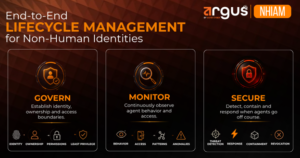
People first. That has been the focus of identity security for a long time. Employees get access, admins collect privileges, and service accounts run apps and processes in the background. AI adds something more. A credentialed, role-defined agent with sufficient permission to perform a task on its own across business systems. Once a machine identity is able to function with this level of independence, questions around ownership, purpose and access start to look very different.
AI agents add a different kind of identity to the mix. Organizations need to know why an agent has access, keep track of what it does over time, and remove that access when its role or purpose changes.
-
Autonomy changes the security equation
We have spent years deciding what a user can do inside an environment. AI agents bring a slightly uncomfortable version of that question with them: what happens when the thing holding the permission can also decide when to use it?
An agent could have legitimate access to a customer database and still make a decision nobody intended it to make. The permission itself may look perfectly reasonable. The trouble can begin with what happens after the permission is used, especially when the agent can continue acting without someone stopping it at each step.
This is why runtime controls are becoming part of the conversation. Gartner, in its July 2026 paper AI Agents Are Insufficient to Secure Agentic AI Today, describes “agents securing agents” as largely aspirational and recommends deterministic runtime controls, identity-based cybersecurity and governance. An organization needs a way to see what an agent is doing while it is doing it, and a practical means of stepping in when its behavior moves beyond the authority it was given.
-
The old vulnerabilities haven’t gone anywhere
There is a temptation to treat AI security as a completely new chapter, with new attack techniques requiring an entirely new set of defenses. Meanwhile, the environment AI is entering still has plenty of familiar weaknesses. An unpatched application is still vulnerable. An exposed cloud resource is still exposed. An identity with excessive privileges still carries the same risk, whether a person or an automated system is using it.
The UK’s National Cyber Security Centre expects AI to increase the frequency and intensity of cyber threats. It also warns that AI could shorten the time between vulnerability disclosure and exploitation. That puts some very familiar security work under greater pressure. Organizations need to know where their exposure sits and be able to act on it quickly. For environments increasingly shaped by AI, continuous exposure management becomes part of being ready for what comes next.
Things Security Leaders Should Get Right Before 2027
-
Decide where AI gets a green light.
AI should not go through one standard security review simply because it is AI. A tool that summarizes documents is a very different proposition from an agent that can access customer information and take action in business systems. Define the risk tiers early, so security does not become the team that has to review every AI experiment from scratch.
-
Know what you are giving the agent before you approve it.
Before an AI system goes live, look beyond the application itself. What identity will it use? What can that identity access? Which data can it reach? What can it change? Those answers should be part of the approval process, rather than something security discovers after deployment.
-
Make sure AI cannot outrun your ability to contain it.
An agent that can act on its own needs more than preventive controls. Security should be able to see its activity, restrict its access and stop or contain it when necessary. Test that capability before handing an agent significant authority. -
Don’t let AI projects hide existing security debt.
A business may be ready to deploy an AI workflow while the environment underneath it still has unpatched systems, excessive privileges or poor visibility. Decide which weaknesses could become more significant because of the new AI access and deal with those first. -
Give the executive team a risk decision, not another security dashboard.
At the executive level, the conversation needs to get beyond how many AI projects are underway. What deserves attention is where those projects have reach into the business, what risks come with that reach and where additional security investment is justified. That also gives the CISO a clearer way to have the budget conversation. If AI is becoming a business priority, the security architecture supporting it has to be part of that investment discussion.
The Balance 2027 Will Require
Whenever a new technology enters the enterprise, it tends to expose gaps that were already there. AI is different in one important respect. We are giving software a level of autonomy that can approach the way humans operate across systems, make decisions and take actions. An agent can introduce risk even when it is acting exactly as it was designed to. It can be given a completely legitimate objective and still use an excessive permission, reach the wrong system or take a path nobody intended while trying to complete that task.
That changes what responsible AI adoption looks like. In 2027, moving AI forward and being cautious about where and how it operates cannot sit in separate conversations. Organizations will need to make room for experimentation and progress while keeping a close eye on the identities, access, exposure and controls surrounding it. Security convergence becomes increasingly relevant here because the risks created by AI do not stay within one security domain.
At Genix Cyber, our work with Argus has followed this direction from the beginning. We have been looking at what happens when security data, controls and context come together across the environment, including the identities AI relies on and the actions AI agents can take.
We will continue exploring that journey as AI becomes a bigger part of enterprise environments.
Explore more about our approach to security convergence and the work behind Argus by Genix Cyber.