

The Modern MSSP Playbook for Expanding Attack Surfaces and Rising Customer Expectations
The Modern MSSP Playbook for Expanding Attack Surfaces and Rising Customer Expectations Every MSSP...
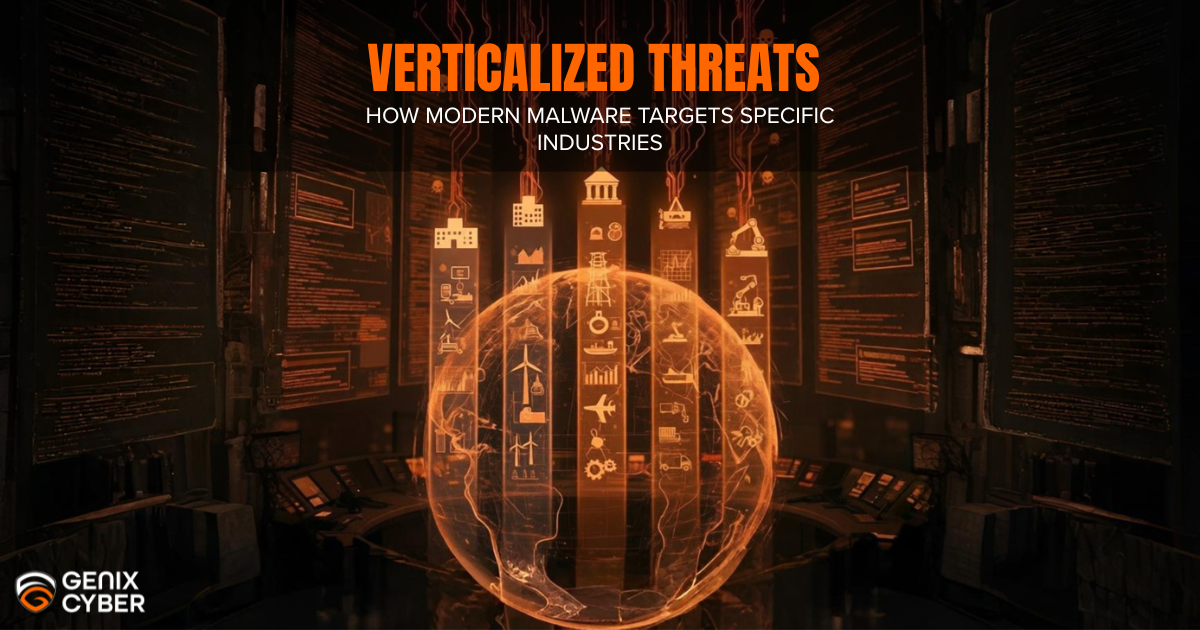
Cyber threats today are not defined by novelty but by precision. Malware is no longer built to spread indiscriminately or cause immediate disruption. Instead, it is designed to understand how specific industries operate, where trust exists, and which security controls are most likely to be bypassed without raising alarms.
What makes this shift particularly dangerous is not the malware itself, but the way it blends into normal business activity. Many of the most damaging incidents in recent years were not caused by unknown vulnerabilities or exotic exploits. They were caused by threats that abused legitimate access, mimicked routine workflows, and operated quietly inside trusted environments.
Awareness of industry-specific malware and the stealth techniques they employ is critical for minimizing risk and protecting digital assets.
Industry | Threat | Impact |
Financial Services | – Anatsa (TeaBot) – TrickBot – Dridex | – Transaction manipulation – Credential theft – Mobile & Enterprise banking attacks |
Healthcare | – Ryuk – Conti – LockBit | – Ransomware targeting clinical systems and operational continuity |
Manufacturing / Industrial | – Triton – Industroyer – EKANS | – ICS/OT disruption – Safety system manipulation |
Retail / E-Commerce | – Magecart | – Client-side skimming, – Payment data theft via checkout pages |
Government / Public Sector | – SUNBURST – RAT variants | – Supply chain compromise – Persistent intelligence gathering |
Supply Chain / Logistics | – NotPetya – Cl0p | – Exploiting trust in partners – Lateral movement – File/service compromise |
Financial institutions are no longer primarily attacked through simple password guessing or generic credential theft. Today’s banking malware is designed to operate inside legitimate authentication flows, blending into real customer and employee activity. Instead of breaking in loudly, it manipulates trusted digital transactions from within.
In mobile environments, threats such as Anatsa target Android banking applications by abusing accessibility permissions and screen overlay capabilities. The malware waits silently on the device and activates only when a specific banking app is opened. This timing allows it to intercept credentials, capture session data, or manipulate transactions in real time without triggering immediate suspicion.
Within enterprise financial networks, banking trojans like TrickBot and Dridex have historically been used to compromise employee endpoints through phishing campaigns. Once inside, they harvest credentials, inject malicious content into banking sessions, and identify high-value systems before escalating toward fraud or secondary payload deployment.
These threats are effective because they operate inside valid user sessions. Activity originates from authenticated devices, approved applications, and legitimate credentials. Command-and-control communication is encrypted and often indistinguishable from normal application traffic. Execution may occur only during sensitive moments such as login verification or transaction approval, reducing behavioral anomalies.
As a result, traditional fraud detection systems may initially interpret the activity as consistent with normal user behavior. Endpoint tools may not flag execution when malicious actions are performed through trusted processes or legitimate application contexts. The compromise appears operationally valid until financial discrepancies or downstream impacts surface.
Healthcare organizations are frequently targeted not because they lack awareness, but because uninterrupted availability is mission-critical. Clinical systems, patient records, imaging platforms, and scheduling applications must remain accessible at all times. Threat actors understand this dependency and design campaigns that maximize operational pressure.
Ransomware groups such as Ryuk, Conti, and LockBit have repeatedly targeted healthcare networks. These campaigns typically begin with phishing, credential compromise, or exploitation of exposed services. Once initial access is established, attackers move deliberately. They enumerate domain controllers, identify backup repositories, and map critical clinical systems before executing encryption.
The objective is rarely immediate disruption. Instead, adversaries seek maximum impact. When ransomware is deployed, it can affect electronic health record systems, diagnostic platforms, scheduling infrastructure, and other core operational services. While most ransomware does not directly infect medical devices themselves, disruption of surrounding IT systems can indirectly impact clinical workflows and patient care delivery.
Healthcare environments introduce structural challenges that adversaries exploit:
Attackers often disable logging, tamper with backup configurations, and time deployment during nights, weekends, or staffing transitions. By the time encryption begins, lateral movement and persistence have already been established. The failure is rarely due to the absence of security tools. More often, it stems from adversaries operating patiently within normal administrative patterns until the moment of execution.
Industrial and operational technology (OT) environments are becoming increasingly connected to enterprise networks. However, visibility across IT and OT systems often remains fragmented, creating blind spots that sophisticated attackers can exploit.
Threats such as Triton, Industroyer, and industrial-focused ransomware like EKANS are specifically engineered to interact with industrial control environments.
Triton demonstrated the ability to target safety instrumented systems, a significant escalation beyond traditional IT disruption. Industroyer was designed to communicate using industrial protocols to manipulate power grid infrastructure. EKANS included functionality to terminate industrial control processes before encryption, indicating awareness of OT environments.
These operations are not opportunistic. They require reconnaissance, understanding of controller configurations, network topology, and safety mechanisms.
OT networks often prioritize uptime and reliability over deep security inspection. Common challenges include:
Malicious commands can resemble legitimate control instructions, making intent difficult to distinguish from routine operations. In some cases, operational failures caused by malicious activity are initially attributed to equipment malfunction or configuration error. Without behavioral correlation across IT and OT environments, adversaries can persist until physical disruption becomes visible.
Retail and e-commerce environments face threats that often bypass traditional internal security because they target the customer interaction layer rather than internal systems. These attacks focus on capturing sensitive data at the point of transaction without touching backend infrastructure.
Magecart-style web skimming malware remains one of the most prevalent threats. It injects malicious JavaScript into checkout pages to capture payment card details as customers complete transactions. Stolen data is sent directly to attacker-controlled servers.
Compromise can originate from several vectors:
These attacks are effective because internal systems remain fully operational, network traffic appears normal, and no malware executes on endpoints inside the retailer’s environment. Client-side manipulation often goes unnoticed, and detection frequently only occurs after payment processors or customers report fraud. By design, these attacks avoid interacting with internal infrastructure, making them invisible to most conventional security tools.
In public sector and government environments, malware campaigns often prioritize long-term access, intelligence gathering, and stealth over immediate disruption. Adversaries aim to remain undetected for extended periods while collecting sensitive information.
Supply chain attacks, such as the SUNBURST incident, highlight this approach. Trusted software updates were weaponized to deploy malware that performed extensive reconnaissance, selectively activated secondary payloads, and communicated intermittently to avoid detection.
Advanced remote access tools are often highly customized for each target, deployed only after careful reconnaissance and validation of the target environment. The emphasis is on strategic infiltration rather than rapid exploitation.
Public sector threats succeed because they operate under the guise of trusted activity:
Traditional security solutions that focus on perimeter defenses, known malware signatures, or high-volume alerts are often ineffective. The result is prolonged, low-visibility access, which can last months or even years before discovery.
Supply chain and logistics networks are uniquely vulnerable because they rely heavily on interconnected systems, shared platforms, and trusted partnerships. Attackers exploit these dependencies to extend their reach, often impacting multiple organizations through a single compromised entity.
Malware campaigns such as NotPetya and more recent data-extortion operations like Cl0p illustrate how attackers leverage trusted integrations. Instead of targeting each organization individually, adversaries compromise an upstream provider, file transfer platform, or shared service. From this single point, they gain access to downstream customers and can propagate malicious activity efficiently across the entire supply chain.
Supply chain attacks succeed because they exploit structural trust:
Organizations frequently become aware of an attack only after operational disruptions affect multiple partners or critical services. By the time traditional alerts are triggered, the malware may have already moved laterally, encrypted files, or exfiltrated sensitive data across several organizations.
Across industries, modern malware follows a familiar playbook. It hides within trusted processes, operates with valid credentials, executes only when high-value opportunities arise, and moves across systems without triggering traditional alerts. By mimicking normal activity and exploiting organizational trust, these threats remain invisible until damage is done.
This recurring pattern highlights a key reality. No single tool or isolated security measure can keep pace with attacks that span identity, endpoints, networks, and cloud workloads. Organizations need security that is pervasive, context-aware, and adaptive, functioning as an ecosystem rather than a patchwork of point solutions.
Argus’ Iron Dome Security embodies this approach. Built from the ground up, it provides unified protection across all business domains, regardless of industry. By continuously monitoring for anomalies, mapping attack paths, and detecting abuse of trust, Argus closes gaps before they can be exploited. Its automated containment and cross-domain correlation ensure that even sophisticated, stealthy threats are intercepted in real time.
In short, as malware evolves to exploit organizational processes, effective defense requires holistic, ecosystem-style security. This approach treats every identity, endpoint, and workflow as part of a single, resilient protective layer. Argus’ Iron Dome is designed to deliver exactly that.
To learn more about Argus, please fill the contact form. We will reach out within 24 hours.
The Modern MSSP Playbook for Expanding Attack Surfaces and Rising Customer Expectations Every MSSP...
What Gartner SRM Summit 2026 Revealed About The Future of Cybersecurity “We are not...
Argus v2026.01 : Now with extended IoT security, Vulnerability detection, and Android security. Argus...

Fill out the form below!